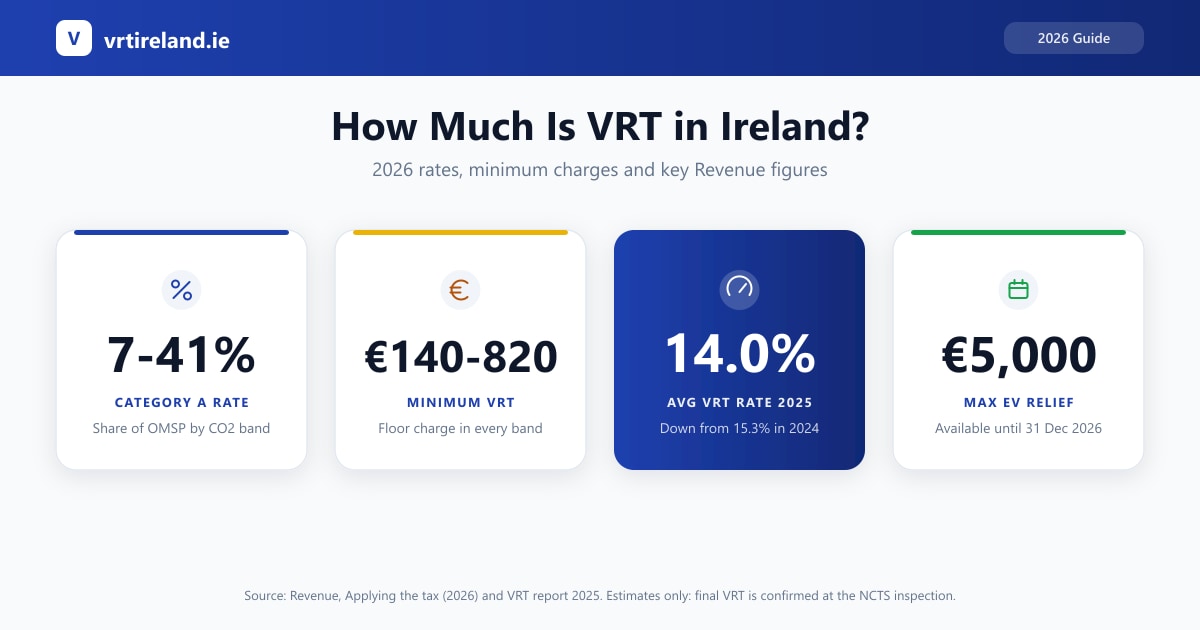
Vehicle registration tax in Ireland costs between 7% and 41% of your car's Open Market Selling Price (OMSP), depending on its CO2 emissions, plus a NOx levy. A typical petrol or diesel car lands around 20%, while most electric cars sit in the 7% band (RTE reporting on Revenue data, 2026). On a family diesel valued at 24,000 euro, that works out at roughly 5,550 euro once the NOx charge is included.
This guide walks you through the full 2026 rate table, the exact formula the Revenue Commissioners apply, and three worked examples in euro, so you can budget with confidence before you buy or import.
VRT rates in Ireland in 2026: the full CO2 band table
For a passenger car (Category A), VRT in 2026 runs from 7% of OMSP for cars emitting 0 to 50 g/km of CO2 up to 41% for cars above 190 g/km. Before running any calculation, you need the rate that applies to your car, and that depends on a single number: its WLTP CO2 figure.
Category A rates from 7% to 41%
Your car's WLTP CO2 value appears on its certificate of conformity and on most vehicle history reports. Check it against the official scale below before you commit to a purchase, because a difference of a few g/km between two versions of the same model can push you into the next band and add hundreds of euro to the bill.
| CO2 band (WLTP, g/km) | VRT rate (% of OMSP) | Minimum VRT |
|---|---|---|
| 0-50 | 7% | €140 |
| 51-80 | 9% | €180 |
| 81-85 | 9.75% | €195 |
| 86-90 | 10.5% | €210 |
| 91-95 | 11.25% | €225 |
| 96-100 | 12% | €240 |
| 101-105 | 12.75% | €255 |
| 106-110 | 13.5% | €270 |
| 111-115 | 15.25% | €305 |
| 116-120 | 16% | €320 |
| 121-125 | 16.75% | €335 |
| 126-130 | 17.5% | €350 |
| 131-135 | 19.25% | €385 |
| 136-140 | 20% | €400 |
| 141-145 | 21.5% | €430 |
| 146-150 | 25% | €600 |
| 151-155 | 27.5% | €550 |
| 156-170 | 30% | €600 |
| 171-190 | 35% | €700 |
| 191+ | 41% | €820 |
Source: Revenue, Applying the tax, 2026.
The scale climbs gently at the bottom and steeply at the top. Electric and plug-in hybrid models usually sit in the cheap opening bands, and between 96 and 140 g/km each step adds less than one percentage point. From 146 g/km onwards the jumps widen to several points at a time, which is exactly where most older petrol and diesel models sit.
Minimum VRT amounts per band
Every band also carries a floor in euro, and Revenue charges the percentage or the minimum, whichever is greater. The floors start at 140 euro in the 0-50 g/km band and rise to 820 euro in the 191+ band. This mainly affects older cars with a low OMSP: 7% of a 1,500 euro runabout is only 105 euro, so the 140 euro minimum applies instead. At the top of the scale, a high-emission car valued at 1,800 euro would owe the 820 euro floor rather than 41% of its value, which comes to 738 euro.
How VRT is calculated: OMSP, CO2 rate and NOx levy
Revenue calculates VRT with one formula: OMSP multiplied by your CO2 rate, plus the NOx levy. Knowing your rate is only half the answer, because the amount you pay depends on the value Revenue assigns to your car, not on the price on your invoice.
The OMSP: Revenue's valuation, not your purchase price
The Open Market Selling Price is Revenue's estimate of what your vehicle would sell for on the Irish market, taxes and duties included (Revenue, assessing the value). VRT is charged on an ad valorem basis, meaning the tax follows this Irish valuation rather than the foreign purchase price. Buy a bargain abroad and Revenue can still tax it on a higher figure.
The VRT formula in practice
The calculation itself fits on one line:
VRT due = (OMSP x CO2 rate) + NOx levy (Revenue manuals)
Run your registration details through an online VRT calculator before you buy, then cross-check against the official Revenue VRT calculator hosted on the Revenue Online Service (ROS). If the two figures diverge, the emissions data you entered probably does not match your exact version of the car.
The NOx levy on top
The NOx levy is a separate charge added to the CO2-based amount, calculated on nitrogen oxide emissions in mg/km. Revenue applies it in three progressive slices (Revenue, 2026):
- 5 euro per mg/km on the first slice
- 15 euro per mg/km on the middle slice
- 25 euro per mg/km above that
Older diesels carry the heaviest NOx charges, and where no certified emissions figure is available the levy is applied at the unfavourable end. Gathering the emissions paperwork before you import is worth real money.
Worked examples: what VRT actually costs in euro
On a 24,000 euro diesel saloon in the 20% band, VRT comes to 4,800 euro before the NOx levy is added. The formula becomes much clearer once you run it on real cars, so here are three typical profiles. Each result is an estimate: Revenue confirms the final figure at inspection.
Electric car: the 7% band
An EV with an OMSP of 35,000 euro sits in the 0-50 g/km band: 35,000 x 7% gives 2,450 euro, with no meaningful NOx charge. Apply the EV relief in force until the end of 2026 and the final bill can shrink to a few hundred euro, or to nothing at all.
Mid-range diesel: the 20% band
Take the benchmark example published by vrt-calculator.ie in 2026: a 2020 Audi A4 2.0 TDI with an OMSP of 24,000 euro in the 136-140 g/km band. The CO2 element is 24,000 x 20%, or 4,800 euro, the NOx levy adds about 750 euro, and the total lands around 5,550 euro.
High-emission petrol SUV: 30% and above
A petrol SUV emitting just over 160 g/km with an OMSP of 45,000 euro falls into the 30% band: 45,000 x 30% equals 13,500 euro before NOx. Cross 170 g/km and the rate climbs to 35%, then 41% above 190 g/km. On expensive high-emission cars, the band does more damage than the purchase price.
VRT on vans, motorcycles and older vehicles
Not every vehicle follows the CO2 bands: light commercial vehicles pay 13.3% of OMSP and Category C vehicles pay a flat 200 euro. The CO2 table only applies to passenger cars, and the rules are simpler for everything else.
Category B and Category C vehicles
Category B covers car-derived and jeep-derived vans, charged at 13.3% of OMSP subject to a minimum charge (Revenue, 2026). Category C takes in larger commercial vehicles, agricultural tractors and vehicles more than 30 years old, all at a flat 200 euro. That flat fee makes the over-30 route the cheapest way to register a classic: a 1990 coupe owes 200 euro no matter what collectors currently pay for it.
Motorcycles: charged by engine size
Motorcycle VRT ignores CO2 entirely. Revenue charges 2 euro per cc up to 350cc and 1 euro per cc thereafter, with the result reduced according to the bike's age. A new 600cc machine therefore starts from 950 euro, while an older bike of the same size pays considerably less.
Importing a car: VRT is only part of the total bill
On a car imported from Great Britain, you typically pay 10% customs duty and 23% VAT on top of VRT. If your car is coming from abroad, the VRT figure alone will understate your real cost, sometimes by half.
Customs duty and 23% VAT on UK imports
Since Brexit, most GB imports attract customs duty of 10% and VAT at 23%, both charged before VRT enters the picture (vrt.ie, 2026). Vehicles bought in Northern Ireland can qualify for VAT and duty exemptions under certain conditions, which is why many Irish buyers now source cars north of the border. Budget for the full stack:
- Purchase price and transport
- Customs duty (10% for most GB cars)
- VAT at 23%
- VRT plus the NOx levy
- NCTS registration fee
The NCTS appointment and the 30 day deadline
Once the car arrives, the clock starts. You must book an NCTS appointment within 7 days of the vehicle entering the State and complete registration within 30 days. The VRT itself is paid at that NCTS inspection, where the inspector verifies the details that drive the final figure.
Reliefs and exemptions that cut your VRT bill
Electric cars qualify for VRT relief of up to 5,000 euro until 31 December 2026, and some drivers moving to Ireland pay no VRT at all. Once you know your gross figure, check whether one of the official reliefs applies before you pay.
Electric vehicle relief until 31 December 2026
The EV relief, worth up to 5,000 euro depending on the car's OMSP, was extended to 31 December 2026 under the Budget measures. Combined with the 7% band, it explains why electric registrations carry the lightest tax load in the country: Revenue's VRT report 2025 shows the weighted average VRT rate fell to 14.0% in 2025, from 15.3% in 2024 and 18.6% in 2019, as lower-emission cars took a growing share of registrations.
Transfer of residence and other exemptions
Moving to Ireland with your own car can remove the bill entirely. The transfer of residence exemption applies when you have owned and used the vehicle abroad for at least 6 months, and you may not sell it within 12 months of registration (Revenue). Narrower exemptions exist for diplomatic staff and for qualifying drivers and passengers with disabilities, each with its own paperwork.
FAQ: your remaining VRT questions answered
Beyond rates and reliefs, a few practical questions come up again and again at registration time.
What happens if I miss the 30 day registration deadline?
Late registration exposes you to penalties and interest on top of the VRT due, and Revenue can detain a vehicle that remains unregistered. The extra cost grows with the length of the delay.
Can I challenge Revenue's OMSP valuation?
Yes. You can appeal the valuation with supporting evidence such as comparable Irish adverts and proof of the car's condition. Motor trade commentary on CompleteCar recommends seeking expert valuation advice first, especially for unusual imports where Revenue's figure can look unrealistic.
Do I pay VRT on a gifted or inherited car?
Yes, in most cases. VRT is triggered by first registration in Ireland, not by payment, so a car you received for free is still taxed on its OMSP unless a specific exemption applies.
Can I get VRT back if I export my car?
Partially, through the Export Repayment Scheme. The car needs an OMSP of at least 2,000 euro to qualify, and the NCTS charges a fee for the export examination (ros.ie, 2026).